If your association has received a recertification notice, or your building is coming up on 25 or 30 years, the part that catches boards off guard is not the inspection. It is what happens after it. The engineer hands you a report listing deficiencies, and a clock starts on correcting them.
That correction work is construction, and it is what 1NSG Corp does. We coordinate the licensed engineer who performs and seals the inspection, then we perform the repairs the report calls for, under Florida Certified General Contractor license CGC1536356.
There Are Actually Three Separate Requirements
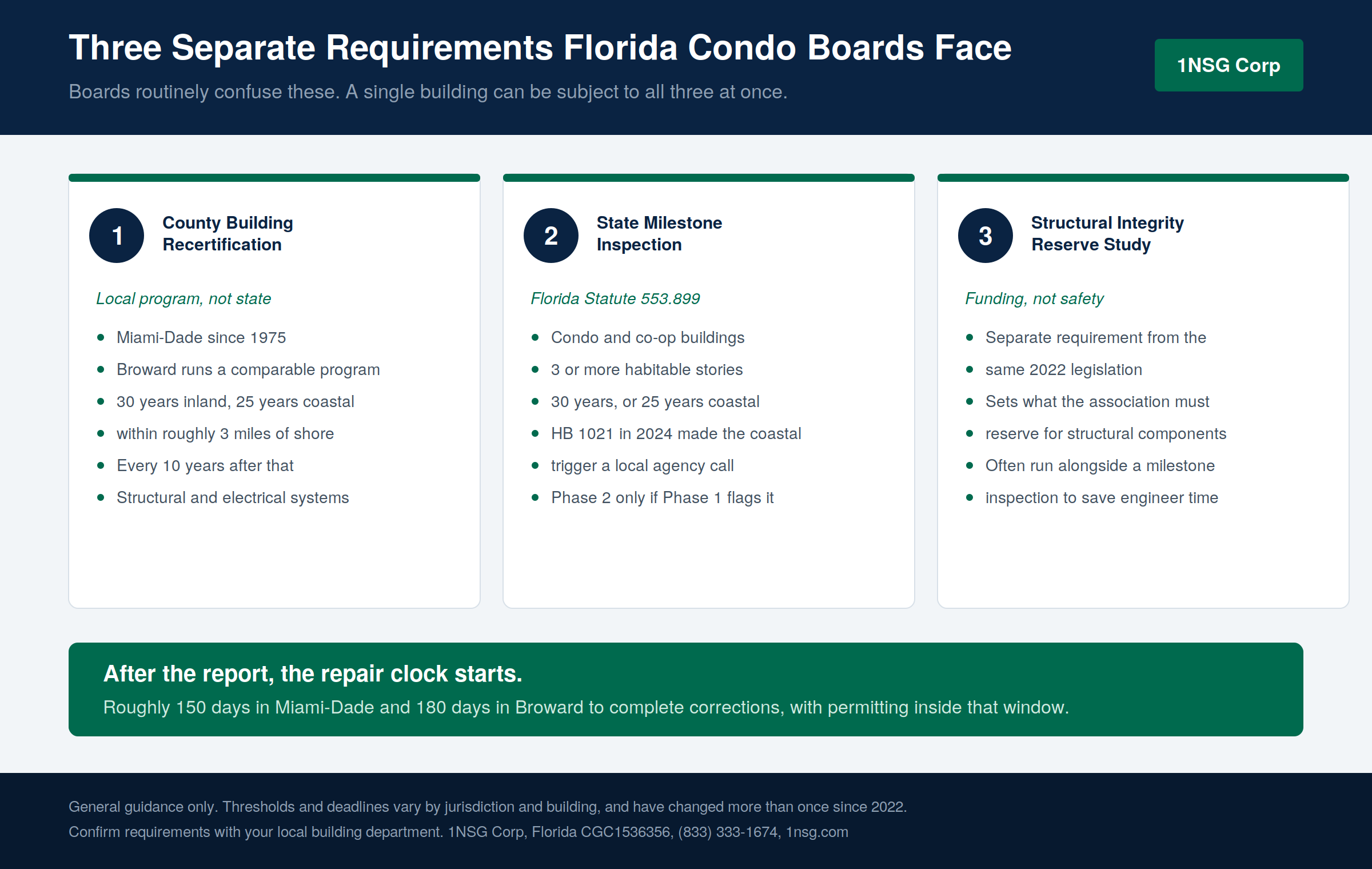
Boards routinely confuse these, and they are not the same thing. A single condominium building in Miami-Dade can be subject to all three at once.
County building recertification
A local program, not a state one. Miami-Dade has run recertification since 1975 and Broward operates a comparable program. Both predate the state law and both are still in force. This is the program most people still call the forty year recertification, which is now out of date as a name. It covers structural and electrical systems, and in Miami-Dade also guardrail and parking lot illumination inspections, which Broward does not require.
State milestone inspection
Created by Senate Bill 4-D after the Champlain Towers South collapse and codified at Florida Statute 553.899. It applies statewide to condominium and cooperative buildings of three or more habitable stories. Phase one is a visual inspection. Phase two is a deeper evaluation, required only if phase one identifies substantial structural deterioration.
Structural Integrity Reserve Study
A separate funding requirement from the same legislation, covering how the association reserves money for major structural components. It is not an inspection of safety, it is a study of what you must fund. Where a milestone inspection is already scheduled, associations frequently run the two together because the engineer is on site anyway.
The Timelines Moved, and Many Buildings Are Already Overdue
The single most common misunderstanding we encounter is a board still working from the old forty year number.
In Miami-Dade, recertification is now generally required at 30 years for inland buildings and 25 years for buildings within roughly three miles of the coast, then every 10 years. Buildings already on the original forty year cycle continue on their established schedule. Broward runs its own thresholds through its Board of Rules and Appeals.
On the state side, the milestone threshold is 30 years, or 25 years for buildings within three miles of a coastline. Worth knowing: HB 1021 in 2024 changed that coastal 25 year trigger from automatic to a determination the local enforcement agency makes. Many South Florida jurisdictions kept it. Some did not. This is exactly the kind of detail a board should confirm rather than assume, because assuming the wrong direction either wastes reserve money or misses a deadline.
The Repair Clock Is the Part That Matters
Once a report identifies deficiencies, the association has a limited window to correct them, commonly cited as 150 days in Miami-Dade and 180 days in Broward from the date of notice, with permitting timelines running inside that window.
This is where associations get into trouble. The engineer’s job ends with the report. Finding a licensed general contractor, getting scope priced, obtaining board approval, pulling permits, and completing the work all has to happen inside that window, and a board that starts looking for a contractor after receiving the report has already spent weeks of it.
How We Work With Your Engineer
To be precise about roles, because it matters legally. A milestone inspection or recertification report must be performed and sealed by a Florida licensed professional engineer or registered architect. 1NSG Corp is a general contractor, not an engineering firm, and does not perform or seal those inspections.
What we do is coordinate the licensed engineer or architect who performs the inspection, and then execute the corrective construction the report requires. You can bring your own engineer, or we can coordinate one through our subconsultant relationships. Either way the report comes from the licensed professional and the repairs come from us, so the association is not managing two disconnected vendors against a deadline.
What We Correct
Deficiencies in these reports cluster in predictable places, and a large share of them fall squarely in our scope.
- Fire rated door assemblies with painted over or missing labels, clearances out of tolerance, or hardware not part of the listing, see fire door inspection and remediation
- Closers that no longer close and latch from the fully open position
- Panic and exit devices that fail to latch or release properly
- Corroded frames and door assemblies, particularly at frame bottoms on coastal buildings
- Stair and corridor openings, and egress path deficiencies
- Guardrail and railing items on the Miami-Dade inspection scope
- Parking lot illumination, striping, wheel stops, and accessibility items, see parking lot work
- Concrete, walkway, and trip hazard corrections
Getting Ahead of It
The associations that handle this well do one thing differently. They have a contractor walk the building before the engineer does, correct the obvious items, and go into the inspection with a shorter deficiency list and a realistic budget.
Doors, hardware, egress, railings, and lot items are visible and correctable in advance. Structural findings are not, and no contractor should tell you otherwise. But shrinking the correctable portion of the list before the clock starts is straightforward and it is worth doing.
Frequently Asked Questions
Can 1NSG perform our milestone inspection?
No. That report must be performed and sealed by a licensed engineer or registered architect. We coordinate that professional and perform the corrective work the report calls for. Any contractor telling you they can seal the report themselves is describing something they are not licensed to do.
Our building is two stories. Does any of this apply?
The state milestone requirement applies to condominium and cooperative buildings three or more habitable stories in height, so a two story building generally falls outside it. County recertification programs have their own scope and can reach a broader set of buildings, so confirm with your building department rather than assuming you are exempt from everything.
We already got our report and the list is long. Where do we start?
Send us the report. We scope the items that fall in our lane, tell you which are quick corrections and which need permitting, and give you a written price and sequence so the board can approve against the deadline rather than guess at it.
Can you work directly with our property management company?
Yes, and usually that is smoother. Managers are typically tracking the deadline and the documentation, and we can report progress in the format they need for the board packet.
Do you handle buildings outside Miami-Dade and Broward?
Yes. The state milestone requirement is statewide, so associations in Palm Beach County, Monroe, and the Treasure Coast face it too, even though those counties do not run the same county recertification programs as Miami-Dade and Broward.
Send us your report or your notice and we will scope the corrections.
This page summarizes requirements in general terms and is not legal, engineering, or code compliance advice. Thresholds, deadlines, and scope vary by jurisdiction and by building, and have changed more than once since 2022. Confirm the requirements applying to your property with your local building department and your licensed design professional.