Service Areas
1NSG Corp works across South Florida, the Treasure Coast, and the Florida Keys. Rather than list every city and postal code, this page explains something more useful: what actually changes about the work depending on where your building sits. Three things genuinely differ by location in this part of Florida, and all three affect what we can install, when your deadlines fall, and what fails first.
1. Whether You Are Inside the High Velocity Hurricane Zone
The High Velocity Hurricane Zone is defined in the Florida Building Code and covers exactly two counties, Miami-Dade and Broward, county wide and without exception. Palm Beach, Martin, St. Lucie, Indian River, and Monroe are outside it, even though they share the same coastline. This surprises a lot of owners.
Inside HVHZ, Miami-Dade and Broward. Exterior openings must carry approval rated for HVHZ use, verified against the code’s testing application standards for impact, pressure, and cyclic loading. This is the practical reason a storefront entrance or an exterior door package in Miami, Hialeah, Doral, Coral Gables, Aventura, Fort Lauderdale, Hollywood, or Pompano Beach cannot simply be ordered from a general catalog. The product and the installation documentation both have to survive the permit review.
Outside HVHZ, Palm Beach through the Treasure Coast and the Keys. Statewide Florida Product Approval is the baseline in West Palm Beach, Boca Raton, Delray Beach, Jupiter, Stuart, Port St. Lucie, Vero Beach, Key Largo, and Key West. Wind pressure requirements still apply and are still significant, particularly in the Keys, but the approval pathway is different from Miami-Dade and Broward.
If a contractor quotes the same exterior door package for a Boca Raton property and a Fort Lauderdale property without mentioning this distinction, that is worth asking about.
2. When Your Milestone Inspection Clock Starts
Under Florida Statute 553.899, condominium and cooperative buildings three or more habitable stories tall require a structural milestone inspection at 30 years of age, based on the certificate of occupancy date, and every 10 years after. For buildings within three miles of a coastline, the threshold can drop to 25 years.
One important nuance many boards have not caught up with. HB 1021 in 2024 changed the 25 year coastal threshold from automatic to a determination the local enforcement agency makes, often based on salt water proximity. Many South Florida jurisdictions kept the 25 year timeline, but it is now a local call rather than a blanket statewide rule. Confirm your building’s timeline with your local building department rather than assuming either number.
Why this sits on a service area page: a beachfront association in Sunny Isles, Hollywood, or Singer Island and an inland association in Weston, Plantation, or Wellington of the same age can be on different clocks purely because of distance from the water. Door and opening deficiencies are a routine finding in these inspections, and correcting them is ordinary work we do.
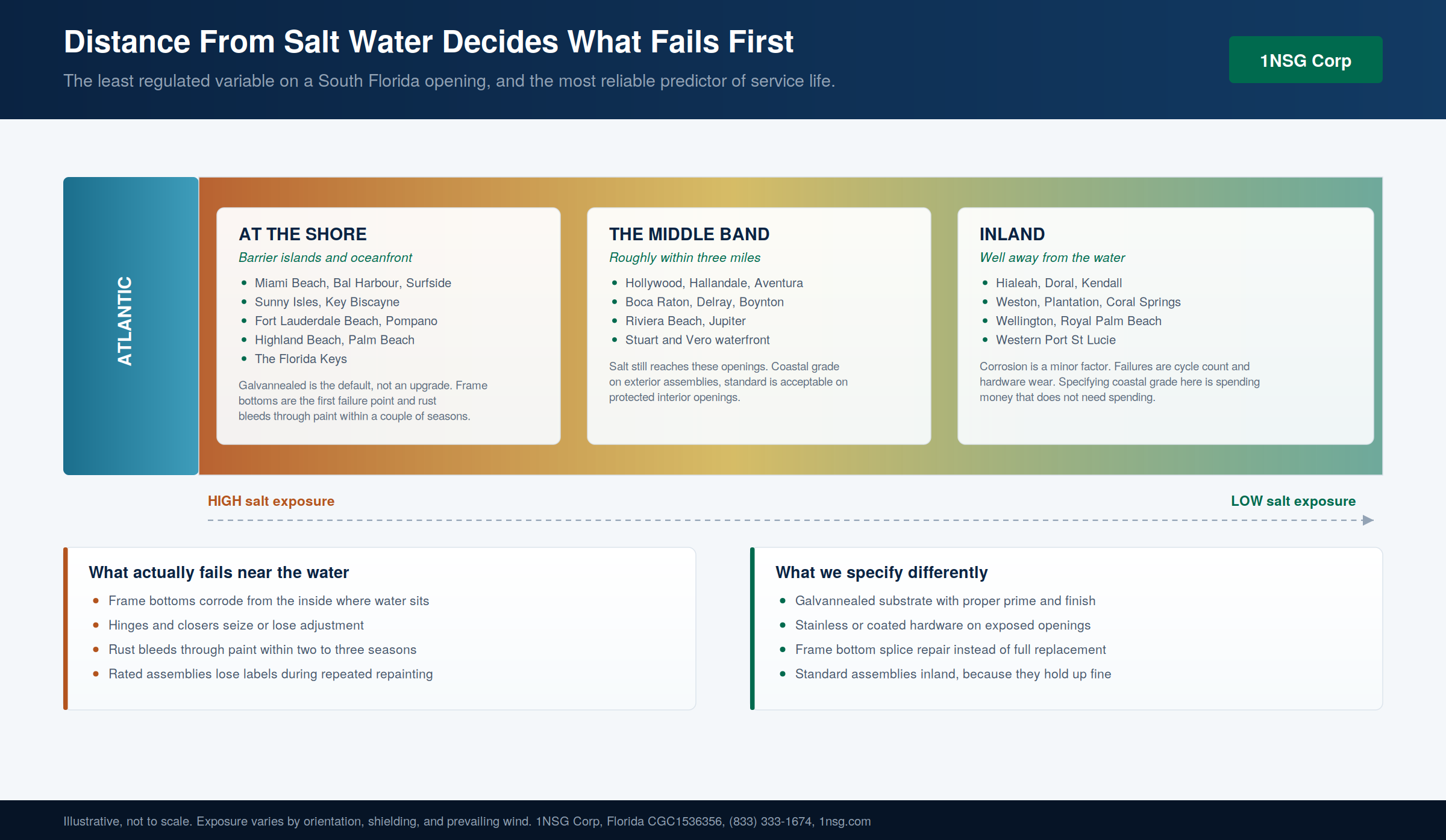
3. How Close the Salt Air Is
This is the least regulated variable and the one that most reliably predicts what fails. A standard steel door and frame within a few blocks of the water will bleed rust through the paint within a couple of seasons. The same assembly ten miles inland can last for years.
On barrier island and near shore properties, from Miami Beach and Bal Harbour up through Lauderdale by the Sea, Deerfield Beach, Highland Beach, and Palm Beach, we specify galvannealed substrate with proper prime and finish as a default rather than an upgrade, and we expect frame bottoms to be the first failure point. Further inland, in Kendall, Davie, Coral Springs, Royal Palm Beach, or Port St. Lucie, standard assemblies hold up and specifying coastal grade everywhere would just be spending your money.
Service Areas by County
Each county page covers what specifically changes there, product approval, inspection timing, and the failure patterns we actually see.
- Miami-Dade County, inside the HVHZ, strictest product requirements in Florida
- Broward County, inside the HVHZ, dense coastal association corridor
- Palm Beach County, outside the HVHZ, different product approval pathway
- Treasure Coast, Martin, St. Lucie, and Indian River counties
Counties We Serve
Core coverage, scheduled routinely. Miami-Dade, Broward, Palm Beach, and Monroe including the Florida Keys.
Treasure Coast. Martin, St. Lucie, and Indian River counties, including Stuart, Port St. Lucie, Fort Pierce, and Vero Beach. On Treasure Coast and Keys work we schedule around travel, so clustering jobs in the same area gets you better pricing. Tell us the location early and we will be straight with you about scheduling.
Frequently Asked Questions
Do you charge more for properties outside Miami-Dade and Broward?
Not as a rule, but travel is a real cost on Treasure Coast and Keys work. Clustering several openings or several properties in the same trip is how that gets managed. We will tell you honestly if a small single item job in a distant area does not make economic sense for either of us.
Our building is in Palm Beach County. Do we still need impact rated doors?
Wind pressure requirements apply throughout South Florida. What changes outside HVHZ is the approval pathway, statewide Florida Product Approval rather than the Miami-Dade and Broward requirements. The opening still has to be rated for the design pressure at your specific location.
How do we find out which milestone inspection deadline applies to us?
Your local building department is the authority, and since the 2024 change the coastal 25 year threshold is a local determination. Start with your certificate of occupancy date and call the building department that has jurisdiction over your address.
Do you work in the Florida Keys?
Yes, throughout Monroe County including Key Largo, Islamorada, Marathon, and Key West. The Keys are outside HVHZ but carry demanding wind requirements and the most aggressive salt exposure in the service area, which affects both product selection and expected service life.
Code and inspection requirements are summarized here in general terms and change over time. Confirm specifics with the authority having jurisdiction over your property.